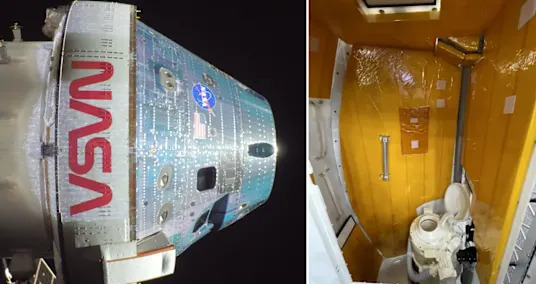
CAPE CANAVERAL, Fla. (AP) — NASA’s moonbound astronauts have reason to celebrate, and not just because their launch went so well. Their toilet is now working.
The so-called lunar loo malfunctioned as soon as the Artemis II crew reached orbit Wednesday evening. Mission Control guided astronaut Christina Koch through some plumbing tricks and she finally got it going.
The bad news is that it’s so cold inside the Orion capsule — 65 degrees Fahrenheit (18 degrees Celsius) — that the four astronauts are digging into suitcases for long-sleeved clothes. Mission Control is trying to warm things up.
The three Americans and one Canadian are on track to bust out of orbit around Earth on Thursday night and zoom to the moon for a lunar fly-around. It will be Mission Control’s first translunar injection since Apollo's swan song in 1972.
Until then, the astronauts are savoring the views of Earth from tens of thousands of miles (kilometers) high. Koch told Mission Control that they can make out the entire coastlines of continents and even the South Pole, her old stomping ground.
"It is just absolutely phenomenal," radioed Koch, who spent a year at an Antarctic research station before joining NASA.
The mission is due to end with a Pacific splashdown on April 10. NASA is counting on the test flight to kickstart the entire Artemis program and lead to a moon landing by two astronauts in 2028. Orion's toilet may need some design tweaks before that happens.
Located in the floor with a door and curtain for privacy, the capsule's lone toilet is based on an experimental commode that launched to the International Space Station in 2020. That station potty barely saw any use and has been out of order for years.
Known as the universal waste management system, the compact toilet uses air suction instead of water and gravity to remove waste, similar to earlier space toilets. It’s also designed to better accommodate female astronauts.
Koch and her crewmates had to resort to a bag and funnel system for urinating until she got the toilet working overnight.
Any toilet — even a fitful one — is better than none if you ask any of the six surviving Apollo astronauts.
NASA's Apollo capsules were too small to accommodate a commode, so the all-male crews relied on bags to relieve themselves throughout the lunar journey. These so-called Apollo bags were repurposed during NASA's later space shuttle flights; they served as backup whenever the shuttle toilet acted up.
___
The Associated Press Health and Science Department receives support from the Howard Hughes Medical Institute’s Department of Science Education and the Robert Wood Johnson Foundation. The AP is solely responsible for all content.
LATEST POSTS
- 1
 From invasive species tracking to water security – what’s lost with federal funding cuts at US Climate Adaptation Science Centers
 - 2Foreign military officials can become Israel's ambassadors, senior IDF commander tells 'Post'
- 3The Conclusive Manual for Spending plan Travel: Opening Undertakings on a Tight budget
- 4Remain Cool and Solid: Top Summer Food sources for 2024
- 54 injured in suburban Philadelphia nursing home explosion file negligence lawsuit


- Figure out How to Amplify the Resale Worth of Your Kona SUV
- Which One Energizes You the Most These Tech Developments
- Is new Harry Styles music on the way? Fans think so, after a cryptic website and posters pop up.
- 12 times rockets and spacecraft crashed and burned in 2025
- The breakout star of NASA's Artemis 2 moon mission isn't an astronaut — it's the space toilet
- Clones of Stumpy, Washington D.C.'s beloved cherry blossom tree, have flowered for the first time
- WATCH: IDF strikes, dismantles missile launchers in southern Lebanon
- Germany ready to assist Syria's reconstruction, says foreign minister
- Discovery of ancient pleasure boat reveals Egypt's maritime history