Protests took place in Tel Aviv, Jerusalem, Haifa, and Beersheba, as a survey found broad but uneven support among Jewish Israelis for Operation Roaring Lion.
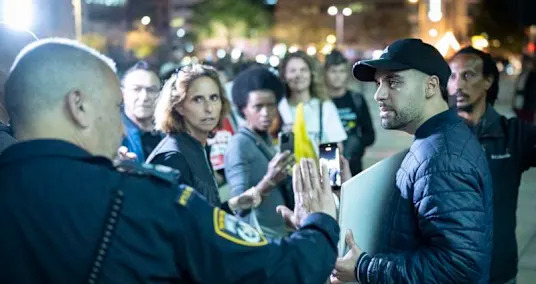
Israel Police arrested 21 anti-war protesters Saturday night as demonstrations against the conflict with Iran expanded in multiple cities despite restrictions on public gatherings.
Protests took place in Tel Aviv, Jerusalem, Haifa, and Beersheba, with hundreds of participants reported in Tel Aviv and Jerusalem and about 100 in Haifa, marking the largest turnout since weekly demonstrations began. Authorities said 13 people were arrested in Tel Aviv and eight in Haifa.
Police said the gatherings were not approved under Home Front Command regulations that ban events with more than 50 people. Officials said the increase in turnout followed calls by groups opposing the government to protest despite the restrictions.
“During a situation assessment that took place at the scene with a Home Front Command representative… it was clarified that there was a real risk to human life and accordingly, Yarkon [precinct] police commander Tzachi Sharabi ordered the gathering to be dispersed,” police said.
Hadash-Ta’al chairman Ayman Odeh, an Arab lawmaker involved in the protests, criticized the police response, calling officers fascists “in the service of the government” and saying they were afraid of “the heroic citizens who went out, despite everything, to make their voice heard.”

Survey shows broad, uneven support for war
The demonstrations come as a March 2026 survey by the Israel Democracy Institute found broad but uneven support among Jewish Israelis for Operation Roaring Lion. Support was strongest on the Right at 87% and about half on the Left.
The survey also found that Jewish and Arab respondents largely agreed that Iran’s resilience has been stronger than expected. Most Jewish respondents said Israeli society could sustain the campaign for up to one month, while 28% said as long as needed. Arab respondents were less optimistic about how long the public could endure the conflict.
A majority of Jewish respondents said Prime Minister Benjamin Netanyahu’s decision was driven by security considerations, while most Arab respondents viewed it as political.
LATEST POSTS
- 1
 This Week In Space podcast: Episode 189 — Privatizing Orbit
 - 2Iran slams UN nuclear watchdog for failing to condemn Bushehr attacks
- 3Rio Tinto resumes operations at three Pilbara port terminals after cyclone Narelle
- 4Five killed in Israeli air strikes on tents near Khan Younis, medics say
- 5Windows to the Previous: An Excursion Through the World's Notable Engineering




- How federal officials talk about health is shifting in troubling ways – and that change makes me worried for my autistic child
- They died 'doing what they loved': The stories of workers in their 80s who died on the job
- Clones of Stumpy, Washington D.C.'s beloved cherry blossom tree, have flowered for the first time
- 6 Methods for further developing Rest Quality
- Why screening for the deadliest cancer in the U.S. misses most cases
- Guns N' Roses 2026 Tour: How to get tickets, presale times, prices and more
- Minute Maid’s frozen juice concentrate is ending after 80 years — and so is a certain kind of kitchen ritual
- The architect of Iran’s military survival remains defiant
- Discovery off Israel’s coast reveals earliest known 2,600-year-old shipment of raw iron